

How Do You Curate an Exhibit About a Battle That Never Happened? The Story of Operation Downfall
When audiences think of a fictional battle, they might imagine dragons, outer space, or science fiction. However, a fictional battle can simply mean a battle that never happened. Unlike the approximately 80 other exhibit cases in the National Museum of the Pacific War's George H.W. Bush Gallery, this case focuses on a battle that was carefully planned but never took place.
Curating an exhibit about Operation Downfall, the planned Allied invasion of Japan during World War II, presented a unique challenge. Unlike other battles represented in the Museum, a simple search of our collections database would not be enough. Instead, I approached the exhibit by comparing Operation Downfall to real events, recreating the historical environment in which the invasion was planned, and focusing on the people who might have been lost.
What Was Operation Downfall?
Operation Downfall was the two-phase American plan to invade mainland Japan. The first stage, Operation Olympic, called for the invasion of Kyushu, Japan's southernmost major island, which would serve as a staging ground for the larger invasion. The second stage, Operation Coronet, called for an even larger assault on the Kanto Plain near Tokyo, striking directly at Japan's political and industrial heart.
In response, Japan developed Operation Ketsu-Go, a defensive strategy that called for the fortification of Kyushu with additional military forces and the mobilization of civilians. Fearing enormous casualties, potentially reaching into the millions, American leaders considered alternatives to a conventional invasion, including the use of atomic weapons.
The debates and scholarship surrounding the atomic bomb make Operation Downfall an important part of understanding both the decision to use atomic weapons and the final stages of the Pacific War.
During the Museum's gallery renovation, we had an opportunity to dedicate an exhibit case to Operation Downfall and place it within the context of the period when the invasion was being planned. This was a time defined by the continuous B-29 firebombing campaign against Japanese cities and the extraordinary levels of violence and loss of life experienced at Iwo Jima and Okinawa.
The challenge was determining which artifacts could tell the story of a battle that never happened.

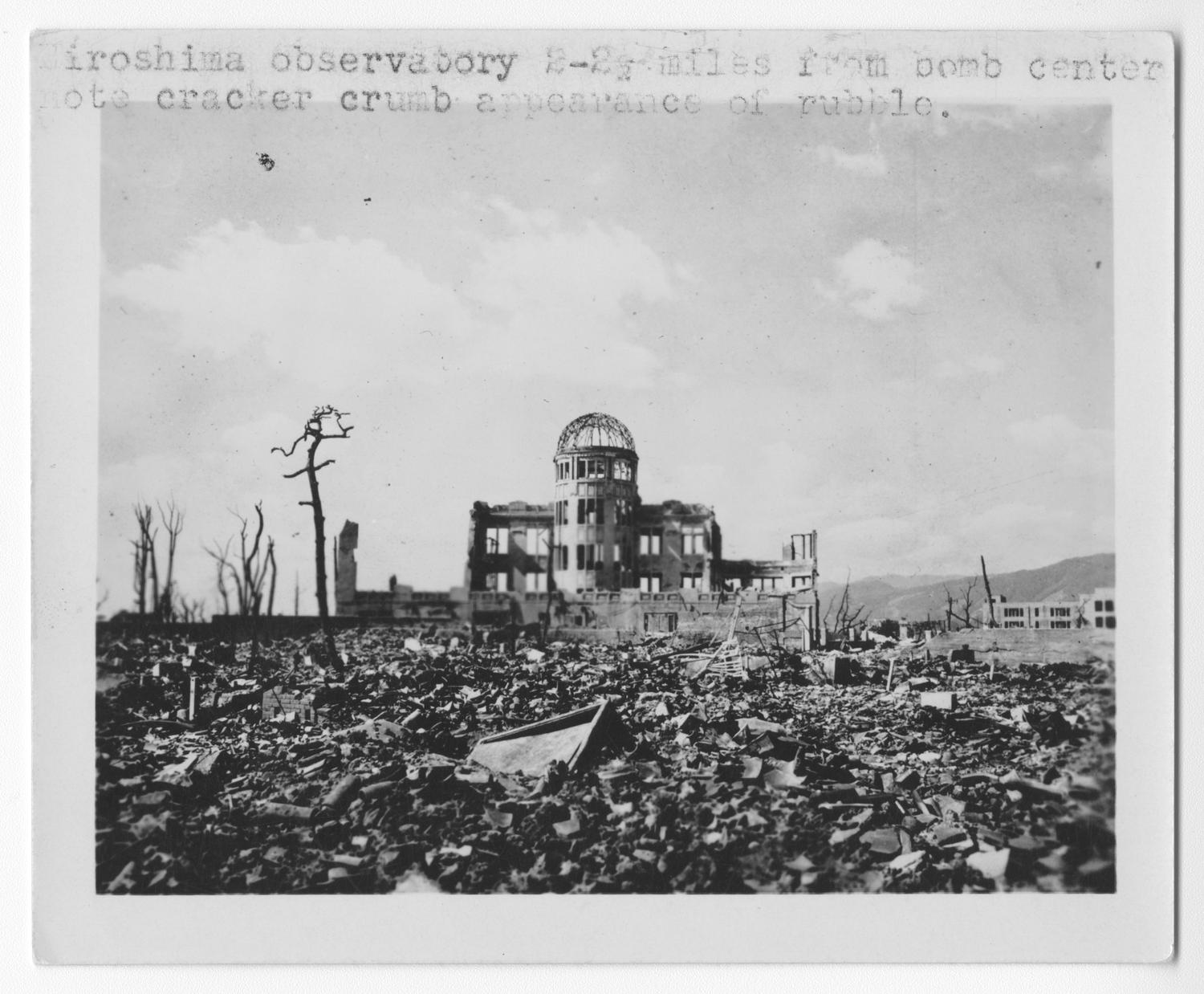
Photograph of the Hiroshima Peace Memorial after the atomic bomb attack. In the foreground are small pieces of rubble. At the top margin of the photograph is typed text reading, "Hiroshima observatory 2-2 miles from bomb center / note cracker crumb appearance of rubble." Raymond Cavness Collection. National Museum of the Pacific War.
The Challenge of Curating an Operation That Never Took Place
Traditionally, our first step in curating an exhibit is to search for major terms associated with each battle in our collections database. The database contains many of our archival materials and all of our three-dimensional objects, allowing us to search for specific medals, personal effects, documents, and other artifacts connected to an event.
For example, the Pearl Harbor Aftermath gallery includes the Medal of Honor awarded to Captain Cassin Young, while the Midway gallery features the hat and watch worn by Kaname Harada. Other cases require greater interpretation or creativity in object selection. In the Doolittle Raid gallery, for instance, we use a medal from the Second Sino-Japanese War to represent the loss and suffering experienced by Chinese civilians in the aftermath of the raid.
However, Operation Downfall never happened. We had no objects from the operation, nothing belonging to someone who participated in the invasion, and no documents directly associated with its execution.
The only object in our collection definitively connected to Operation Downfall was an article from Yank, Far East, published after the war. Although the article includes a valuable map of the proposed invasion, that alone could not carry an entire exhibit case.
Instead, I approached the case through three methods: comparing Operation Downfall to a real event, reconstructing the environment in which the invasion was planned, and focusing on the people who would have been called upon to fight.
Comparing Operation Downfall to the Normandy Invasion
Operation Coronet Was Expected to Involve More Than Three Times as Many U.S. Divisions as Normandy
This fact immediately stood out during my research. It not only demonstrated the enormous scale of the proposed invasion but also provided an opportunity to include additional objects in our Operation Downfall exhibit. By comparing the planned invasion to Normandy, I could expand my search to objects from the European Theater that might help convey the scale of the operation.
The Normandy invasion, the largest amphibious assault in history, remains a defining moment of World War II, remembered for its courage, sacrifice, and fierce combat. It is also a battle with which many visitors are already familiar. Using Normandy as a comparison allowed visitors to understand the scale of Operation Downfall through an event they already knew.
Although our Museum focuses on the Pacific Theater, we also have a small collection of objects from the European Theater. Two of those objects became particularly useful for this case: Dwight Shepler's artwork Battle for Fox Green Beach, Normandy and the binoculars of Chief Petty Officer Herschell Randall, who served with the Navy Seabees at Omaha Beach, France.
These objects helped convey the scale of the proposed invasion while also addressing a practical curatorial challenge: finding physical artifacts that could bring the exhibit to life.

Battle for Fox Green Beach, Normandy — Dwight Shepler. Naval History and Heritage Command.
Setting the Stage for the Invasion of Japan
During this period, Japan was increasingly surrounded, while its resources and supplies were being depleted, much as the United States had experienced in December 1941.
This is illustrated by a copy of The Daily Target, a newspaper printed on Saipan, which features a headline about plans to launch additional bombing raids on Japan using B-29 bombers based on Okinawa. The newspaper helps establish Japan's growing isolation and the increasing reach of Allied forces.
By this point in the war, the Allies had essentially run out of territory to take before reaching the Japanese home islands. This is particularly important within the context of the galleries that follow the Operation Downfall case, which focus on Iwo Jima and Okinawa, the final major islands standing between the advancing Allied forces and the Japanese home islands.
Together, these galleries help visitors understand the progression of the Pacific War toward the planned invasion of Japan.
Remembering the People Who Might Have Fought
Lastly, and most importantly, I chose to highlight those who would have been called upon to serve and those who might have been lost during Operation Downfall.
One artifact that helps tell this story is the Marine Corps ring of Private First Class Ralph J. Geiger of the 1st Marine Division.
Plans for the invasion of Japan included all six Marine divisions. Three would take part in Operation Olympic. The other three, including the 1st Marine Division, were set for the second phase, Operation Coronet.
The ring gives visitors something that a map or strategic plan cannot: a tangible connection to an individual who could have been part of the invasion.
Operation Downfall was not simply a military plan on paper. Had it taken place, thousands upon thousands of individual service members would have been sent into combat, and many would likely have been killed or wounded. At the same time, the possibility of those casualties became one of the central considerations in the decision-making surrounding the end of the war and the use of the atomic bomb.

Photograph of the staging of the Operation Downfall exhibit case. Photograph by Suzi McGarraugh.
Bringing the Story of Operation Downfall to Life
The Operation Downfall exhibit presented a unique curatorial challenge. By comparing the planned invasion to real events, recreating the historical environment in which it was planned, and focusing on the people who might have been lost, I was able to build an exhibit around an operation that never took place.
The goal was not simply to explain what Operation Downfall was, but to help visitors understand what the Pacific War looked like at the moment when an invasion of Japan was being considered.
By placing the planned invasion alongside the realities of Normandy, the B-29 bombing campaign, Iwo Jima, Okinawa, and the individual service members who might have participated, the exhibit gives visitors a way to consider the enormous scale and potential human cost of Operation Downfall.
In doing so, it also provides important context for understanding the difficult and controversial decisions surrounding the final months of the Pacific War and the use of the atomic bomb.
Ultimately, the Operation Downfall exhibit accomplishes two goals: helping visitors better understand a pivotal moment in World War II while demonstrating how museum artifacts can tell the story of an event that never happened.